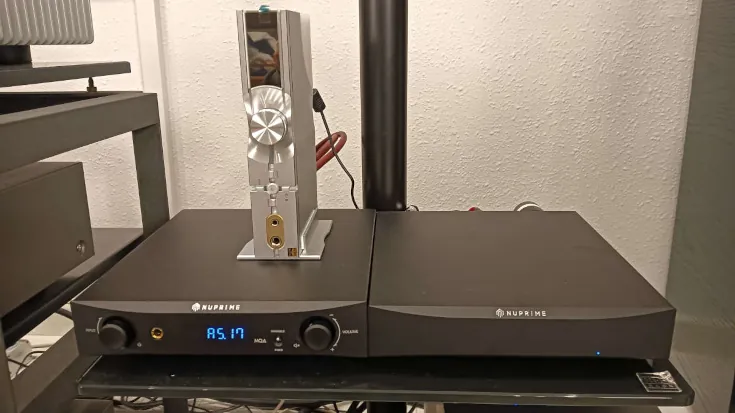
Perfect Stranger

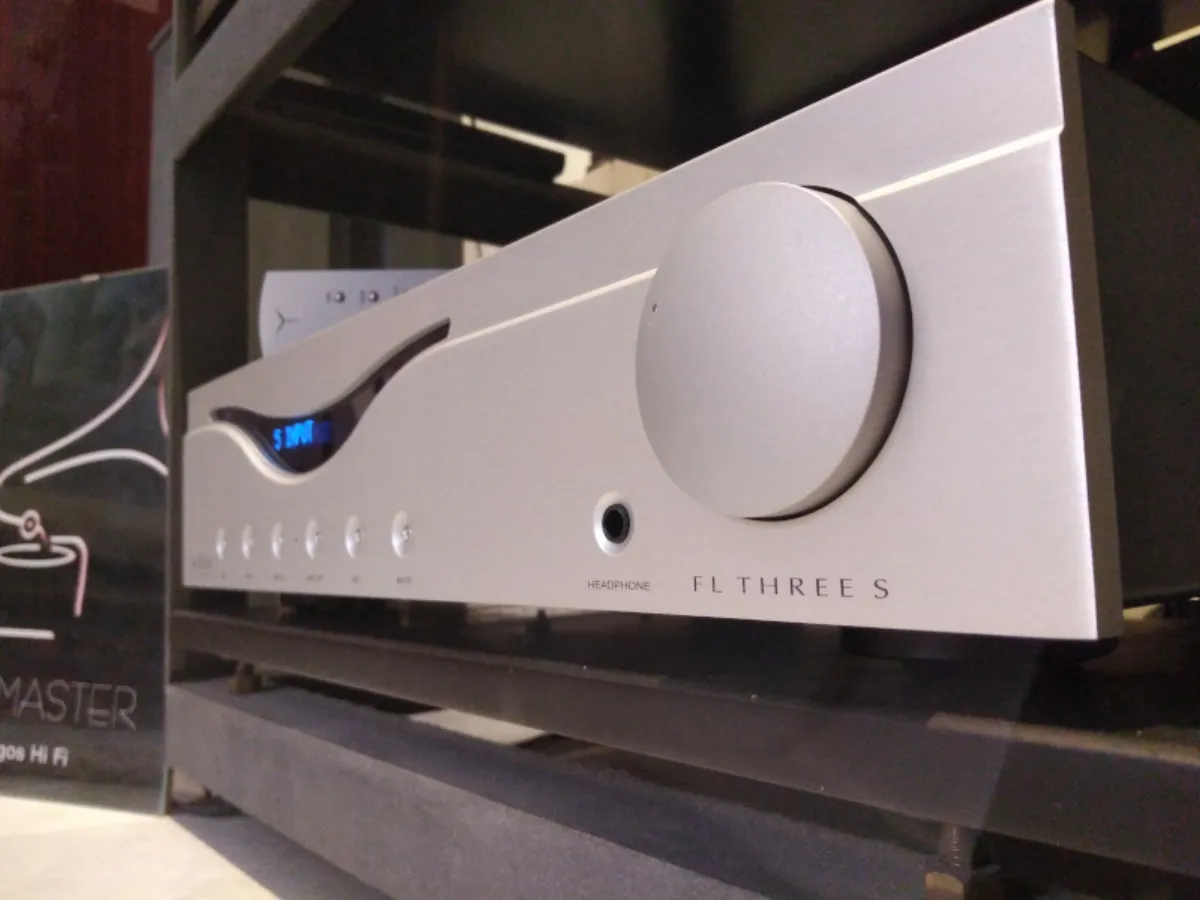
I had just placed it on the rack shelf and manually turned up the volume knob a little, when I noticed it, literally crouching down and in line with the speakers. Two seconds of music, in one of the “bad” spots in the room, and the Audia Flight FL Three S made its mark.
It's not the first time this has happened to me, but I didn't think it would be possible in this case, since theoretically the guest, compared to the “resident” amplifier, has technical characteristics that might lead us to think, at first glance, of nuances rather than general trends. Two seconds.
I find reading the technical specifications of components extremely boring. I skim through them with little interest. Once I am clear that the devices are compatible with each other and what parameters I have to respect, the rest loses its appeal for me. If a manufacturer has achieved an admirable technical feat but the result is normal, it is not worth my while.
First contact
Normally, following the unboxing trend, I would have to say something like “perfectly protected and blah blah blah.” The day I receive a package at home with this type of material and it is poorly packaged, I say so on the cover. When I picked it up to prepare it for the first photos, two ideas came to mind: robustness and imbalance.
Robustness. The structure of the box is absolutely solid, and at no point does it feel weak or prone to twisting, which could damage the internal components. I won't name names, but there are products out there with this problem.
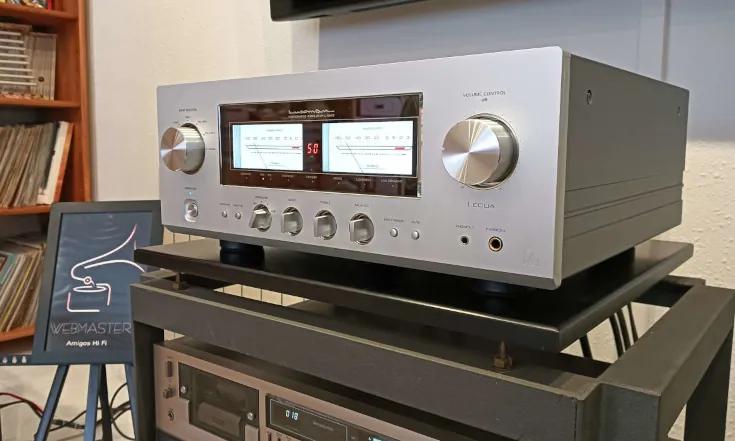
Imbalance. The weight of the amplifier is much greater on one side than the other due to the presence of the 600VA toroidal transformer. The FL-Three S has a not inconsiderable eight power supplies to minimize signal contamination between the different sections of the amplifier. However, the weight is unbalanced between the right and left sides. I prefer amplifiers where these parts are located in the center of the case, giving a uniform weight to both sides. That said, once you put it on the corresponding shelf, you will forget about these things forever, which, incidentally, are not very important.
The control buttons on the front of the device are small, attractive, and serve its basic functions: power, source selector, mute, etc. A large display shows your current selection at all times. An extremely delicate potentiometer controls the volume. And finally, a very useful and increasingly difficult to find feature in amplifiers of this level, a 6.3 mm headphone jack.
Back to the power volume control. My tolerance for music volume when I decide to listen at minimum levels is very strict. Bordering on paranoia, I want to choose the sound pressure meticulously, which is why amplifiers with a large signal jump between steps get on my nerves. Gains of 4 or 5 percent are excessive for my criteria, and I have to “play” with a preamp to compensate for these imbalances. In this case, our guest is superb. Come and see, this is how I want them all to be in terms of precision... but bigger. I find it too small to hold in my hand; it's large in diameter but doesn't protrude enough to be ergonomic. And you pick up the remote control and forget about everything else, but I like to turn the volume up “by hand.”
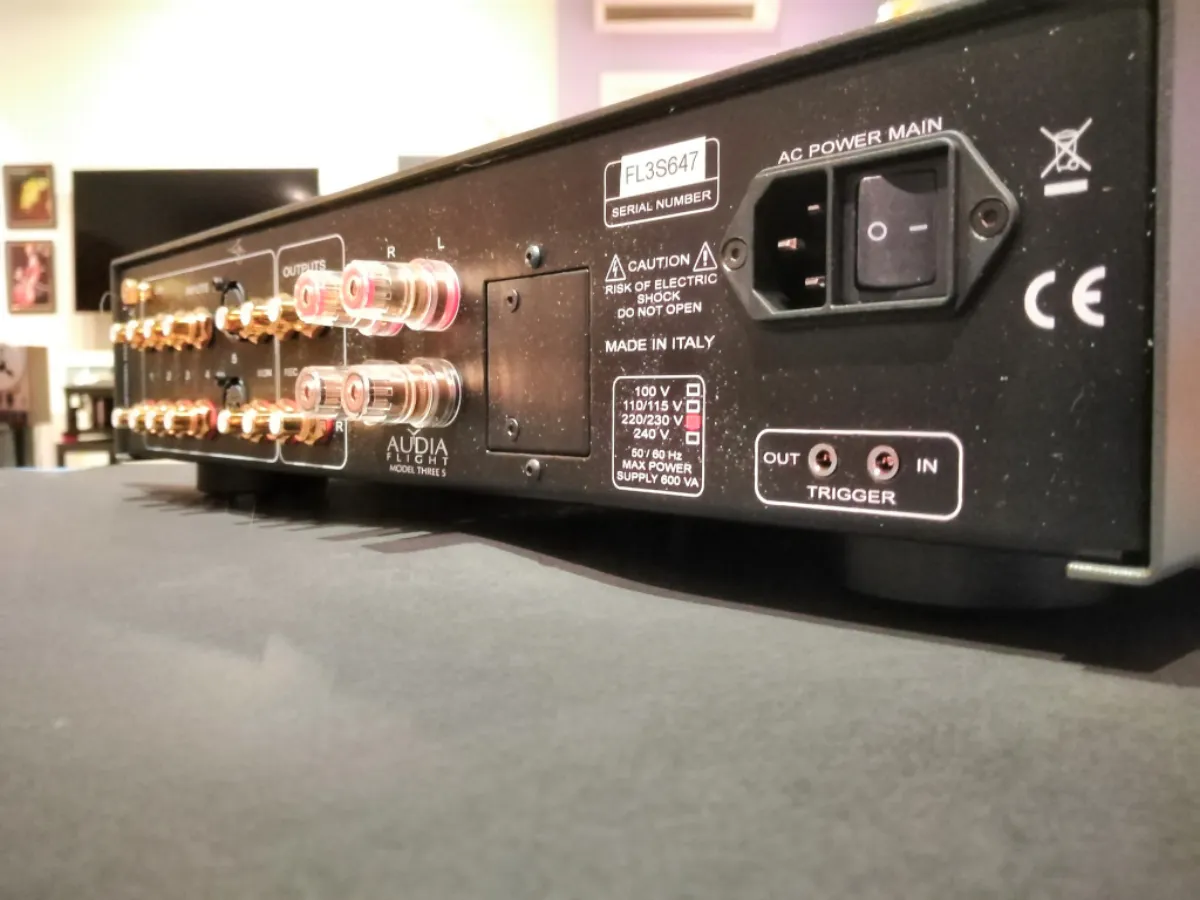
Detail of the rear connections
Connections. Apart from the front headphone jack, there are five inputs, one of which is balanced. The model reviewed does not include the two additional DAC and phono preamp options, so these could not be evaluated. All of the connectors are of obvious high quality and are in keeping with the rest of the amplifier, which can be described at this point as a balanced device in all respects, with nothing that stands out negatively. Even the feet are so well designed that I sincerely believe that nothing more is needed at this level.
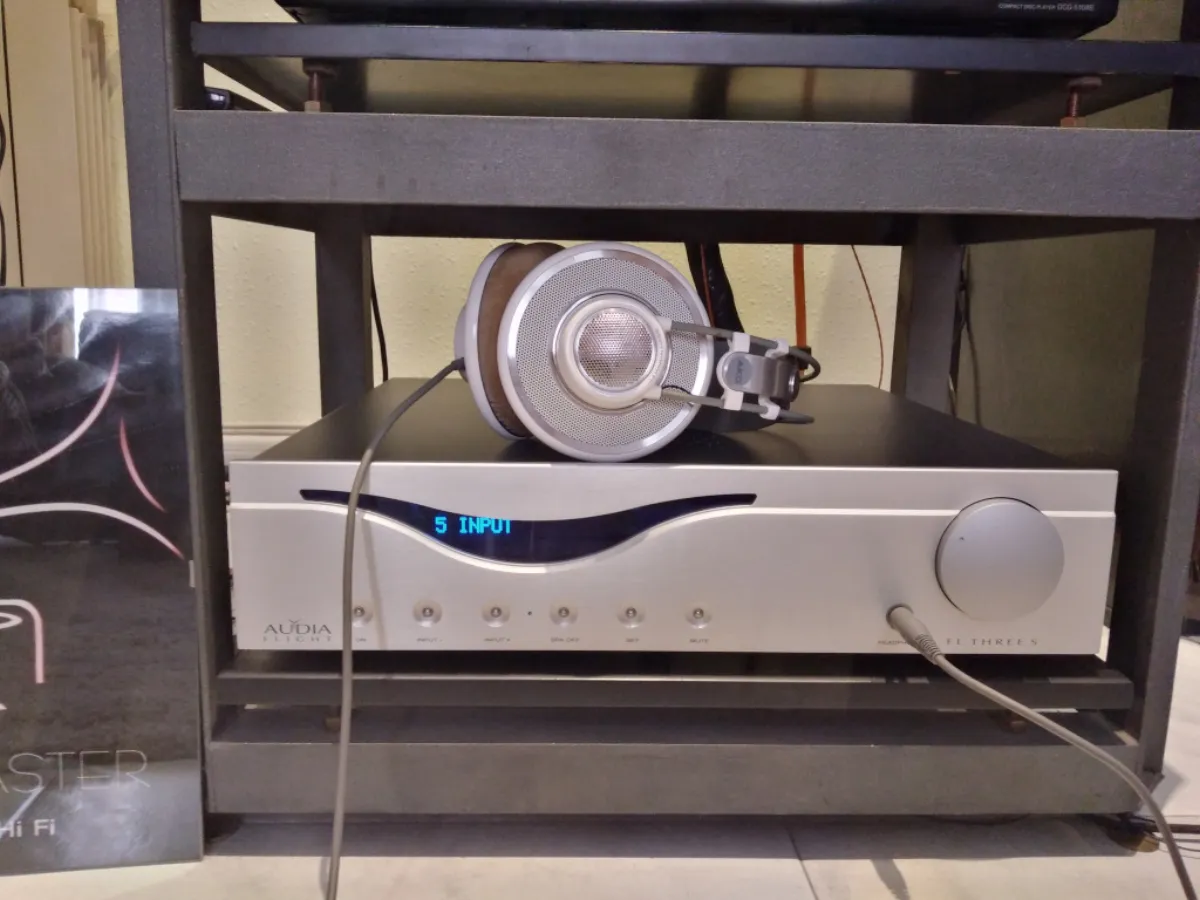
Audia Flight FL Three S with AKG K-701
Headphone amplifier
Obviously, it would be like using a sledgehammer to crack a nut, but the amplifier gives me the option of connecting my AKG K-701 (open headphones) and I am surprised to find that this is not just another element thrown in there, but rather a conscious choice for two reasons. The first is that the quality I have been able to appreciate through the speakers is the same as I identify in the headphones. We often take a step back in these conditions, but this is not the case here, and that's why it's worth pointing out. And secondly, and no less importantly, instead of having a switch on the headphone connection to “turn off” the speakers (sadly popular), we have to press one of the buttons on the front to mute them, not Mute but SPK OFF.
Music always tells us the truth
I have decided to highlight a few tracks in particular. I have really spent many hours enjoying the amplifier, and once we had “got to know each other,” I made a playlist with a heavier workload in its comfort zone to gradually move further and further away from it. Tastes are personal, and the faster you identify mine, the more useful my comments will be to you. Over time, I think that even someone who is on the opposite side of the spectrum from me may be convinced that a particular device is right for them.
Coladito. Back in 1999, Maná left us this huge piece on “MTV Unplugged.” Drummer Alex González and Luis Conte created one of those memorable moments where percussion and mastery come together to create ephemeral art, which luckily we can recover and relive at any moment. I think that if I could only listen to this composition in my life, no one would be able to take the Audia Flight FL-3S out of my hands, not even in my dreams.
Knocking At Your Back Door. Thousands of watts are fired off by Deep Purple on the “Nobody's Perfect” tour. In a moment of fun with the audience, they begin to play fragments of all kinds of music, including Beethoven's “Für Elise.” As in a DJ mix, the rhythms follow one another until the low-frequency organ notes invade the entire sound space, preparing for the entrance of those three repetitive notes that make the song impossible to mistake. Here he continues to play at home and prove once again that he is a true rock champion, giving space and life to a type of music that tends to saturate the room with sound, sometimes leaving you with a strange feeling.
Industrial Revolution . The god of electronic music before he became nothing, as Jean Michel Jarre is today, left us the album “Revolutions” for posterity. Jarre was a composer who was fanatical about sounds and worked with magnificent people who created new and personalized sound banks for each LP he released. Well, the Roland D-50 used in that recording roared with tremendous force, imposing its order and control of the situation.
Yesterday. Sir McCartney has a version of this legendary song on “Give My Regards to Broad Street” that is a cult favorite of mine. It is one of my recurring favorites, well known and recognized in each of its silences, not to mention the notes. Here, at this point, we take a couple of steps down. I don't think this is a demerit of the amplifier at all, simply that we had reached heaven and were returning to earth. The voice loses a bit of its naturalness, becoming somewhat bright and subtle, but I notice it.
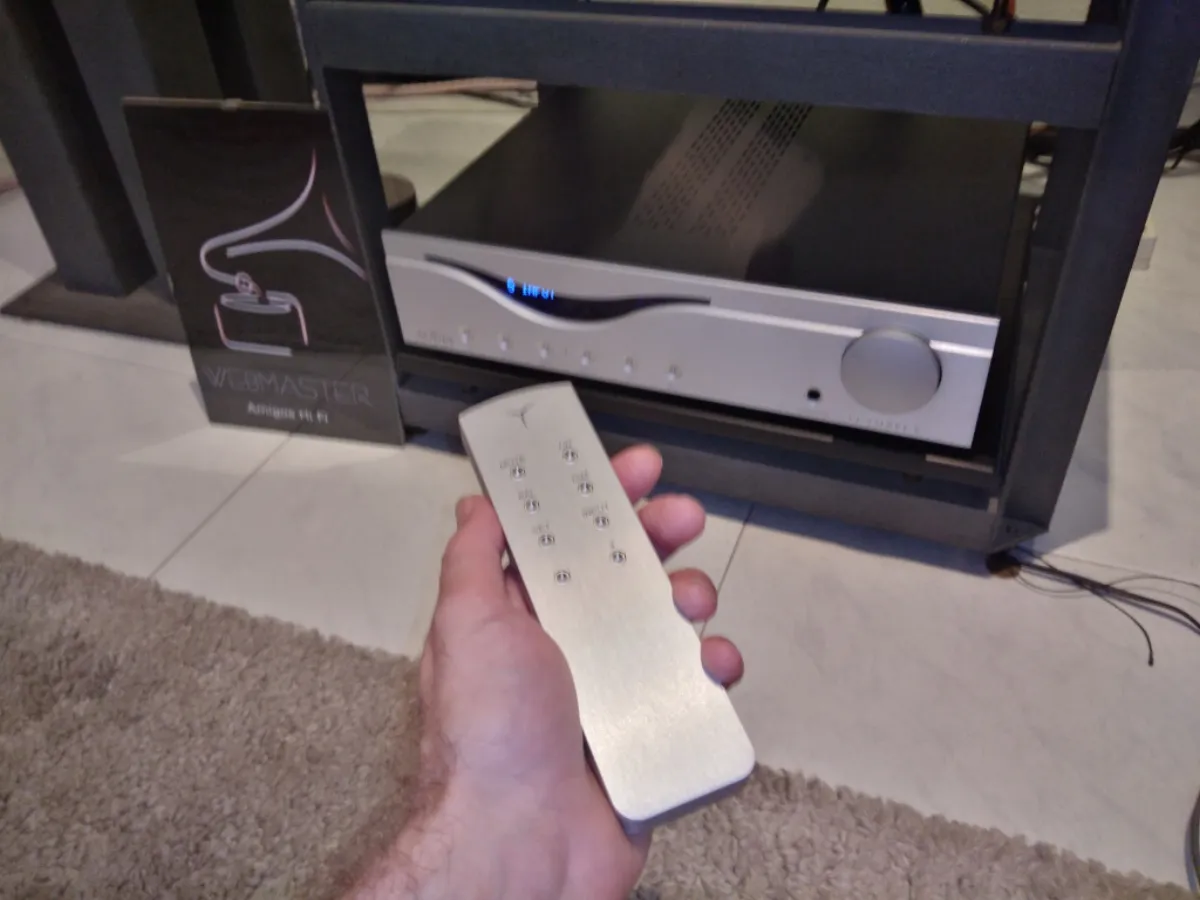
The metal remote control does its job well and is the right size for use, as it fits perfectly in the hand.
Final conclusions
I am very familiar with the sound pattern produced by this superb amplifier. Although this is my first time using it, I had already heard it before. My auditory memory took me back many years to a visit to one of the best private recording studios in Spain. I am talking about Estudis 44.1, where one of the few analog mixing desks currently in operation was located. While I was in the control room chatting with the sound technician, he ran all kinds of tests on me, from the most dramatic ones, such as the automatic setup of the desk, to the modification of small parameters of a channel to hear how it could be distinguished in the final result. We are talking about music taken from the mixing console, not from the master (a later step), which is very different. So, this long introduction is to say that the Audia Flight FL 3S could well be an amplifier for that function. The way it treats all frequencies in the audible spectrum with identical precision, without adding anything, for better or for worse, makes it nothing more than an amplification machine. With all the harshness that this entails, as it strips bare and exposes any possible imperfections in the recording or source. Just like in a recording studio, where the technician needs all that information to be able to work professionally with the sound. That's its charm.
Final conclusions (2)
Cables don't make any sound. They just connect two points without adding anything. Well, now that I've said what I had to say to appease the cable radicals, I can continue. To hell with the nonsense!
I was left with a bad taste in my mouth because I felt I hadn't been able to get the most out of the amplifier. And you can't live like that. I replaced the interconnect cables with the speakers with some I made myself, following the verbal instructions given to me by Juan Pablo Montero (R.I.P.). Briefly, I can say about the cables that in exchange for a loss of definition at the extremes, both high and low, they treat the midrange in a way that gives the sound a tube-like quality that makes vocals their forte. With this change in the setup, we could say that the previous list of selected tracks is practically reversed. And this is the best praise I could give the Audia Flight, as it proves capable of transforming and mutating according to its traveling companions.
More review
-
-
Technics EAH AZ80, positive evolution
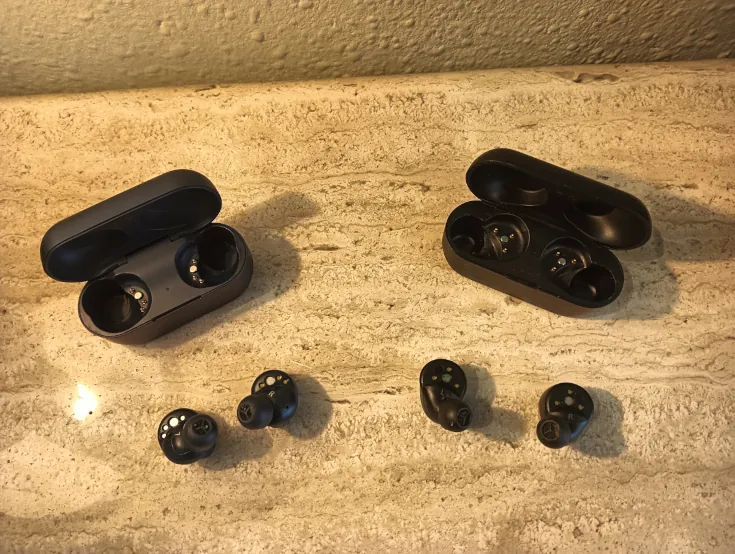
Technologically speaking, this model showcases the most refined work available.
-